

Kyle & Co Publishes New Category Compass Report to Bring Clarity to the Fast-Growing AI Interviewer Market
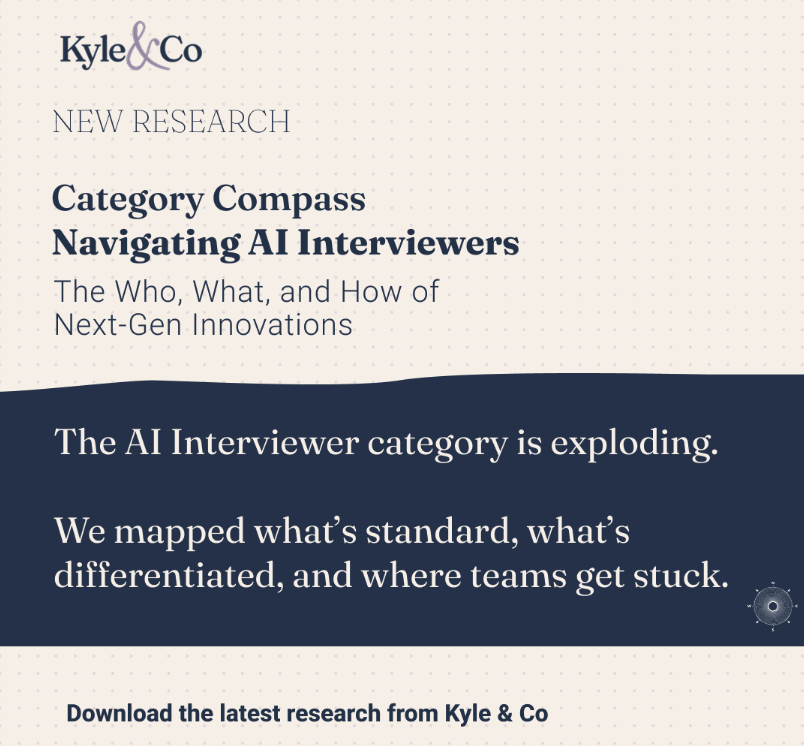
Category Compass
New research benchmarks 12 solution providers and reveals why AI interviewers are spreading faster than governance can keep up.
AI interviewers aren’t plug-and-play. You need to know how they actually work, where they fit into your current solution stack, and your recruiting process.”
NEW YORK, NY, UNITED STATES, February 17, 2026 /EINPresswire.com/ -- Kyle & Co, the analyst and advisory firm founded by talent technology industry expert Kyle Lagunas, today announced the release of its latest Category Compass report: “Navigating AI Interviewers: The Who, What, and How of Next-Gen Innovations.” The new research provides an evidence-based view of one of the fastest-growing (and most misunderstood) categories in talent acquisition technology: AI interviewers.— Kyle Lagunas, Founder & Principal Analyst, Kyle & Co
AI interviewers have quickly emerged as a distinct layer of automation in recruiting, not simply add-ons to ATS platforms or interchangeable with scheduling, transcription, or assessment tools. But as the category expands, Kyle & Co’s research finds that buyer understanding has not kept pace with vendor innovation, creating a widening gap between what these tools can do and how organizations are actually deploying them.
A Category Expanding Faster Than Shared Norms
Kyle & Co created the Category Compass to help talent leaders, HR tech buyers, and governance stakeholders navigate fast-moving, ambiguous categories before they are ready for rankings. Rather than declaring “winners” and “losers,” the Compass benchmarks current-state capabilities and surfaces patterns that help organizations evaluate fit, readiness, and risk in a category evolving faster than shared norms.
“AI interviewers aren’t plug-and-play,” said Kyle Lagunas, Founder & Principal Analyst at Kyle & Co. “You need to know how they actually work, where they fit into your current solution stack, and where they fit into your recruiting process. Their greatest value lies in their ability to generate evaluative insight consistently and at scale, not in replacing human judgment.”
What the Research Found
Kyle & Co’s analysis found that most organizations are adopting AI interviewers in targeted, experimental use cases, particularly at the top of the funnel, rather than deploying them enterprise-wide. Early adoption is concentrated in high-volume, repeatable hiring scenarios such as frontline roles and early-career hiring, where automation can increase recruiter capacity while keeping risk contained.
The report also highlights a persistent readiness gap: vendor capabilities are advancing faster than buyer maturity. Many organizations purchase advanced AI interviewing functionality, but default to conservative configurations that underutilize it, often due to late-stage governance involvement, weak interview design discipline, or internal uncertainty about defensibility and trust.
The Five Core Capabilities That Matter
To bring structure to the market, Kyle & Co evaluated AI interviewer solutions across five core capability areas designed to reflect how these tools are built, deployed, experienced, and governed in real-world hiring environments:
– Candidate Experience
– Recruiter & Hiring Team Experience
– Measurement & Insights
– AI Capabilities & Model Design
– Integration & Implementation
This approach intentionally treats AI interviewing as more than a technology decision. It frames it as a design and governance challenge, one that requires alignment between process maturity, stakeholder readiness, and the boundaries of acceptable automation.
Differentiation Isn’t Where Most Buyers Expect
While many AI interviewer capabilities are quickly becoming standard, Kyle & Co found that meaningful differentiation is emerging in a smaller set of high-impact areas that shape trust, usability, and long-term value. These include fraud detection and identity verification, candidate preparation and practice interviews, evidence-linked recruiter insights, multilingual nuance beyond simple translation, and depth of customer success and enablement.
Candidate experience also emerged as one of the strongest signals of success or failure. Poorly introduced AI interviews can erode trust and cause candidate drop-off to increase quickly, often before recruiting teams realize what is happening. As a result, leading organizations increasingly treat candidate experience not as a “nice-to-have,” but as a governance concern.
A Benchmark, Not a Scoreboard
The report benchmarks capabilities across 12 AI interviewer solution providers, based on a structured evaluation process that included a 32-question RFI, live 60-minute vendor briefings and demonstrations, scoring grounded in observable evidence, and vendor fact-checking and validation.
Most importantly, Kyle & Co’s findings reinforce that there is no universally “best” AI interviewer, only better-fit solutions based on role type, hiring volume, workforce context, and organizational risk tolerance.
Kyle & Co’s “Navigating AI Interviewers” Category Compass report is available now. Read and download the full report.
Evan White
Evan White PR
+1 509-995-9105
email us here
Visit us on social media:
LinkedIn
Legal Disclaimer:
EIN Presswire provides this news content "as is" without warranty of any kind. We do not accept any responsibility or liability for the accuracy, content, images, videos, licenses, completeness, legality, or reliability of the information contained in this article. If you have any complaints or copyright issues related to this article, kindly contact the author above.
