

More Electric Aircraft Market Set to Reach USD 17.84 Billion by 2035 as Aviation Electrification Accelerates Worldwide
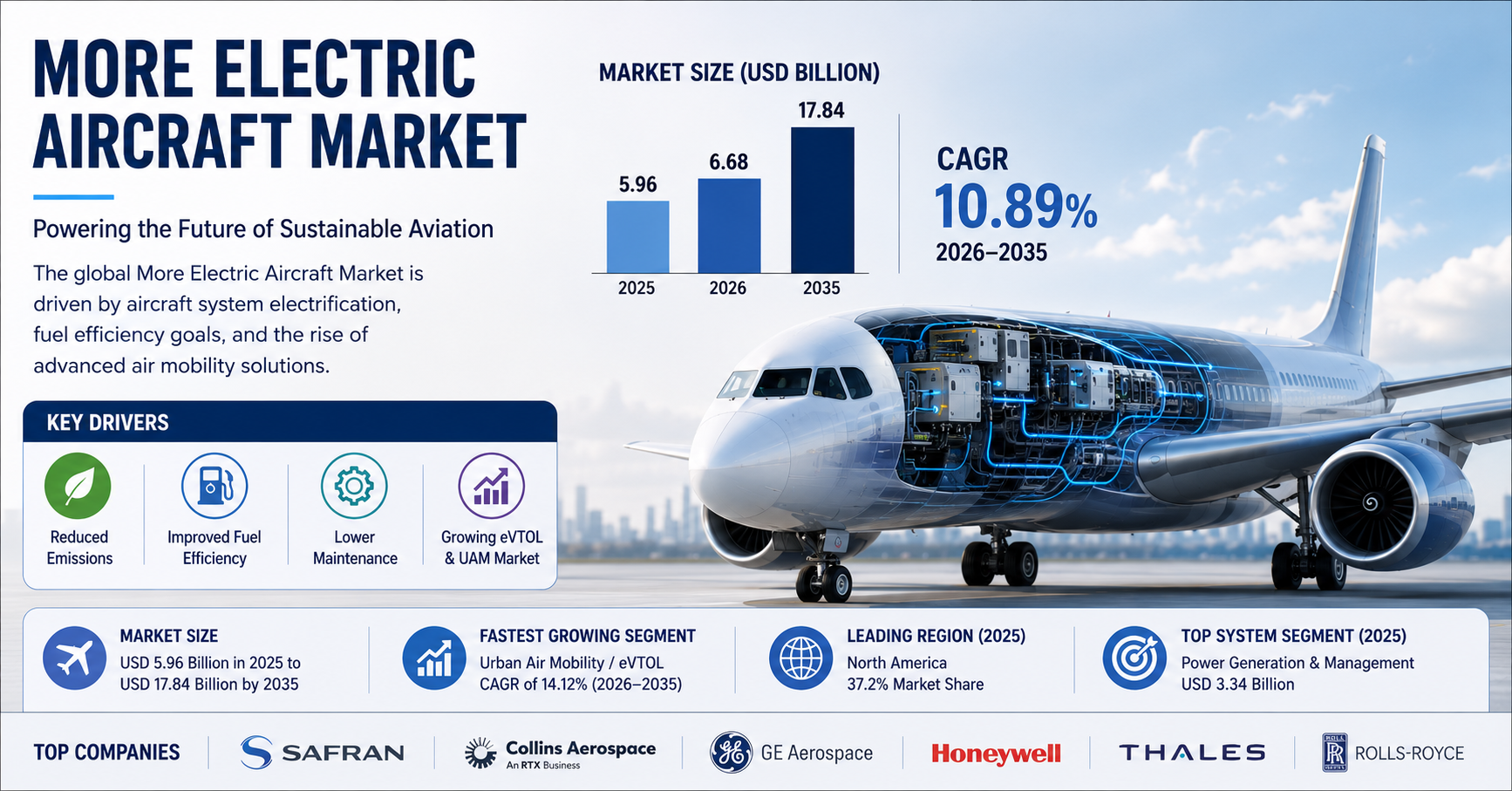
More Electric Aircraft Market
The transition toward more electric aircraft represents one of the most significant technological shifts in modern aerospace engineering. Aircraft manufacturers, system integrators, and component suppliers are increasingly replacing conventional hydraulic, pneumatic, and mechanical systems with advanced electrical technologies. This transition is enabling improved fuel efficiency, lower maintenance requirements, reduced aircraft weight, and enhanced environmental performance.
Growing regulatory pressure related to aviation emissions, rapid advancements in power electronics, increasing defense modernization initiatives, and the emergence of urban air mobility platforms are creating substantial momentum for market expansion. As commercial and military aviation operators pursue sustainable aviation strategies, more electric aircraft technologies are becoming integral to next-generation aircraft programs.
Market Overview:
More electric aircraft utilize electrical power for functions that were traditionally performed using hydraulic, pneumatic, or mechanical systems. These systems include power generation, flight controls, thermal management, environmental control systems, actuation systems, and auxiliary functions.
The market's growth trajectory is supported by global decarbonization initiatives and increasing investments in electrified aviation technologies. Aviation stakeholders are increasingly adopting electric architectures to improve aircraft performance while meeting stringent environmental targets.
The shift toward electric subsystems is also helping aircraft manufacturers achieve operational advantages through reduced fuel consumption, enhanced reliability, and simplified maintenance procedures. Consequently, demand for advanced electrical systems, power management solutions, and high-voltage distribution technologies continues to rise across the aviation ecosystem.
Key Market Drivers:
1. Increasing Pressure to Reduce Aviation Emissions
One of the primary factors driving the More Electric Aircraft Market is the growing focus on carbon reduction within the aviation sector. International and regional regulatory frameworks are encouraging airlines and aircraft manufacturers to adopt cleaner technologies. As emissions reduction targets become more stringent, operators are investing in electrification technologies that help reduce fuel burn and operational emissions. More electric aircraft architectures contribute significantly toward achieving these sustainability objectives while improving overall aircraft efficiency.
2. Growing Adoption of Wide-Bandgap Semiconductor Technologies
The introduction of advanced silicon carbide (SiC) and gallium nitride (GaN) semiconductor technologies is reshaping aircraft electrical systems. These technologies offer higher power density, lower energy losses, and reduced component weight compared to traditional semiconductor solutions. Modern aircraft power systems increasingly utilize these advanced materials to enhance electrical efficiency and improve thermal performance. The resulting benefits are encouraging broader implementation across both commercial and defense aviation platforms.
3. Rising Jet Fuel Costs
Airlines worldwide continue to face pressure from fluctuating fuel prices. More electric aircraft technologies provide a pathway to improve fuel efficiency through optimized power management and reduced dependency on traditional mechanical systems. By lowering energy consumption and improving aircraft performance, electric systems help airlines reduce operating expenses while supporting long-term sustainability goals.
4. Defense Aircraft Electrification Programs
Defense modernization initiatives are generating significant demand for high-capacity electrical systems. Future military aircraft require advanced power generation capabilities to support next-generation sensors, electronic warfare systems, communications equipment, and directed-energy technologies. As defense agencies continue investing in advanced aircraft platforms, demand for more electric architectures is expected to grow substantially.
5. Expansion of Urban Air Mobility
The emergence of electric vertical takeoff and landing (eVTOL) aircraft is creating new opportunities for electrification technologies. Urban air mobility platforms rely heavily on advanced electrical systems, battery management technologies, and high-voltage power architectures. As certification milestones are achieved and commercial deployments expand, eVTOL programs are expected to contribute significantly to future market growth.
Request Sample PDF of Report: https://www.marketresearchfuture.com/sample_request/1245
Latest Market Trends:
1. Emissions Regulation Creating Long-Term Demand
Environmental regulations are increasingly shaping procurement decisions across the aerospace industry. Airlines and manufacturers are actively seeking technologies that support compliance with evolving sustainability standards. This trend is accelerating investments in electric aircraft subsystems and encouraging broader adoption of electrified architectures across both existing and future aircraft platforms.
2. Growing Importance of Power-Dense Electronics
Aircraft developers are prioritizing lighter and more efficient electrical components to improve overall aircraft performance. High-power-density electronics are becoming critical enablers of next-generation electrification programs. The growing use of advanced converters, inverters, and electrical distribution systems is helping manufacturers achieve weight reductions while improving energy efficiency.
3. Rapid Progress in eVTOL Certification
The urban air mobility sector continues to make significant progress toward commercial deployment. Certification activities for multiple eVTOL programs are advancing globally, creating demand for electrical propulsion technologies and supporting infrastructure. This trend is fostering innovation across the broader more electric aircraft ecosystem and encouraging investment in scalable electrical architectures.
4. Increasing Integration of Digital Technologies
Digital twin platforms, predictive maintenance systems, and intelligent power management solutions are becoming essential components of electrified aircraft operations. These technologies enable operators to optimize system performance, reduce maintenance costs, and improve aircraft availability through data-driven decision-making.
Emerging Opportunities:
1. Retrofit Programs for Existing Aircraft Fleets
A major opportunity exists in upgrading legacy aircraft with modern electrical systems. Thousands of commercial aircraft currently in service are expected to undergo modernization programs during the coming decade. The installation of electric environmental control systems, advanced power management technologies, and electromechanical actuators can deliver meaningful efficiency improvements while extending aircraft operational life.
2. Convergence of eVTOL and Conventional Aviation Supply Chains
Many suppliers are positioned to serve both traditional aircraft manufacturers and emerging eVTOL developers. Shared requirements for power electronics, electric motors, battery systems, and electrical distribution technologies are creating economies of scale. This convergence is expected to lower production costs while accelerating technology development across multiple aviation segments.
3. Expansion of Indigenous Aircraft Programs in Asia-Pacific
Several Asia-Pacific nations are investing heavily in domestic aerospace development initiatives. These programs increasingly incorporate advanced electrical systems and electrification technologies. The resulting demand is creating opportunities for component manufacturers, system suppliers, and technology providers seeking to participate in regional aerospace growth.
4. Growth of Predictive Maintenance Services
Electrified aircraft generate large volumes of operational data that can be leveraged for predictive maintenance applications. Manufacturers and service providers are increasingly developing recurring revenue models based on digital monitoring, diagnostics, and maintenance optimization. This trend is expected to create attractive long-term opportunities beyond traditional hardware sales.
Segment Analysis:
1. By Aircraft Type
Commercial Aviation - Commercial aviation held the largest share of the More Electric Aircraft Market in 2025, accounting for approximately 41.8% of total market value. The segment's leadership is supported by ongoing fleet modernization initiatives, increasing adoption of advanced electrical systems, and growing emphasis on fuel efficiency. Commercial airlines continue to prioritize technologies that reduce operating costs while improving environmental performance.
Military Aviation - Military aviation generated USD 1.72 billion in revenue during 2025. Defense organizations are increasingly investing in electrified systems to support advanced mission capabilities and future combat aircraft requirements. The need for enhanced power generation, thermal management, and electrical distribution capabilities is driving continued growth within this segment.
Urban Air Mobility / eVTOL - Urban Air Mobility (UAM) and eVTOL platforms represent the fastest-growing aircraft type segment, projected to expand at a CAGR of 14.12% through 2035. Growing urbanization, increasing traffic congestion, and advances in electric propulsion technologies are supporting strong long-term growth prospects for this segment.
General Aviation - General aviation accounted for approximately 5.9% of market revenue in 2025. Electrification initiatives within flight training, recreational aviation, and light aircraft applications continue to support steady market development.
3. By Platform
Fixed Wing - Fixed-wing aircraft dominated the market with a 66.8% share in 2025. The extensive global fleet of commercial and military fixed-wing aircraft, combined with ongoing electrification programs, continues to generate substantial demand for advanced electrical systems.
Rotary Wing / Powered Lift - Rotary-wing and powered-lift aircraft are expected to achieve a CAGR of 11.24% through 2035. Growing deployment of eVTOL aircraft and modernization of helicopter platforms are contributing to strong segment expansion.
4. By System
Power Generation & Management - Power generation and management systems represented the largest system segment, generating USD 3.34 billion in 2025. The increasing complexity of aircraft electrical architectures and demand for high-voltage power distribution solutions continue to support segment growth.
Actuation System - Actuation systems are expected to register a CAGR of 11.15% through 2035. The replacement of hydraulic systems with electromechanical alternatives is helping reduce aircraft weight while improving reliability and maintenance efficiency.
Thermal Management System - Thermal management systems accounted for 14.3% of market revenue in 2025. As aircraft electrical loads increase, effective thermal management becomes increasingly critical for maintaining performance and reliability.
Other Systems - Other systems generated approximately USD 0.41 billion in 2025 and include applications such as electric taxiing, landing gear systems, and advanced lighting technologies.
5. By End User
OEM - Original Equipment Manufacturers accounted for 56.4% of market revenue in 2025. The integration of electrification technologies into new aircraft programs continues to support strong OEM demand.
Aftermarket - The aftermarket segment is projected to grow at a CAGR of 11.38% through 2035. Increasing interest in retrofit programs and supplemental certification upgrades is creating substantial opportunities for aftermarket service providers.
Regional Analysis:
North America - North America remained the leading regional market in 2025, accounting for 37.2% of global revenue. The region benefits from strong aerospace manufacturing capabilities, significant defense spending, extensive research investments, and active development of advanced electrification technologies. The United States represents the largest contributor within the region, supported by ongoing military modernization initiatives and commercial aerospace innovation.
Europe - Europe captured approximately 28.5% of global market revenue in 2025, making it the second-largest regional market. The region's growth is supported by extensive investments in sustainable aviation technologies, collaborative research initiatives, and strong participation from leading aerospace manufacturers. Countries such as the United Kingdom, France, and Germany continue to play important roles in advancing aircraft electrification programs.
Asia-Pacific - Asia-Pacific is expected to register the highest regional CAGR of 11.18% through 2035. Rapid aviation growth, expanding domestic aircraft manufacturing programs, increasing government support, and rising investments in electrification technologies are driving regional expansion. China, India, Japan, and South Korea are emerging as important growth engines within the global market.
South America - South America generated approximately USD 0.19 billion in market revenue during 2025. The region's growth is supported by regional aircraft development initiatives, fleet modernization activities, and increasing interest in sustainable aviation technologies.
Middle East & Africa - The Middle East & Africa region is forecast to expand at a CAGR of 8.74% through 2035. Defense modernization programs, airline fleet renewal strategies, and emerging urban air mobility initiatives are contributing to market growth across the region.
Competitive Landscape:
The More Electric Aircraft Market is characterized by the presence of established aerospace technology providers and specialized electrical system manufacturers. Companies are focusing on innovation, strategic partnerships, technology development, and product portfolio expansion to strengthen their market positions.
Safran SA - Safran is a leading provider of aircraft electrical systems, power generation technologies, and electric taxiing solutions. The company continues to invest heavily in next-generation electrification technologies for commercial and defense applications.
Collins Aerospace (RTX) - Collins Aerospace offers advanced power generation, actuation, thermal management, and electrical distribution systems. Its broad aerospace portfolio positions the company as a key systems integrator within the market.
GE Aerospace - GE Aerospace is actively developing generators, power conversion technologies, and hybrid-electric propulsion solutions. The company continues to expand its electrification capabilities through ongoing research and development initiatives.
Honeywell Aerospace - Honeywell provides advanced generators, auxiliary power systems, and power electronics solutions. The company's electrification strategy focuses on improving aircraft efficiency and supporting emerging aviation applications.
Thales Group - Thales develops electrical power distribution systems, flight control technologies, and integrated avionics solutions that support aircraft electrification initiatives across civil and defense markets.
Rolls-Royce plc - Rolls-Royce is advancing hybrid-electric propulsion technologies and high-capacity power systems designed to support future aircraft architectures.
BAE Systems - BAE Systems develops advanced power management technologies and electrical systems for military aircraft applications.
Liebherr Aerospace - Liebherr Aerospace specializes in environmental control systems, actuation technologies, and thermal management solutions that support aircraft electrification programs.
Recent Developments:
March 2024 - Joby Aviation received FAA special airworthiness criteria approval for its all-electric air taxi platform. The milestone supports the company's progress toward future type certification and commercial deployment.
January 2024 - Honeywell introduced a 1 MW turbo-generator designed for hybrid-electric flight applications. The system targets regional aircraft and eVTOL platforms, supporting the industry's transition toward higher levels of electrification.
Future Outlook:
The More Electric Aircraft Market is expected to witness substantial transformation over the next decade. Advancements in megawatt-class propulsion systems, high-voltage electrical architectures, intelligent power management technologies, and next-generation battery solutions will continue reshaping aircraft design.
Growing emphasis on sustainability, increasing regulatory support, expanding urban air mobility ecosystems, and rising investments in advanced aerospace technologies are expected to accelerate market adoption. As electrification moves from demonstration programs to large-scale deployment, the industry is poised to enter a new era of efficient, sustainable, and technologically advanced aviation.
With a projected market value of USD 17.84 billion by 2035 and strong growth across commercial, military, and emerging aviation segments, the More Electric Aircraft Market is positioned to become a cornerstone of the future aerospace industry.
Browse More Reports:
Hybrid Electric Aircraft Market
https://www.marketresearchfuture.com/reports/hybrid-electric-aircraft-market-32634
Electric Aircraft Market
https://www.marketresearchfuture.com/reports/electric-aircraft-market-6109
Sagar Kadam
Market Research Future
+1 628-258-0071
sales@marketresearchfuture.com
Visit us on social media:
LinkedIn
Facebook
X
Legal Disclaimer:
EIN Presswire provides this news content "as is" without warranty of any kind. We do not accept any responsibility or liability for the accuracy, content, images, videos, licenses, completeness, legality, or reliability of the information contained in this article. If you have any complaints or copyright issues related to this article, kindly contact the author above.
